
Laura McCue
In a senior oboe recital
With Keun Young Sun, Piano
Please silence all electronic devices


Trio for Piano, Oboe, and Viola, Op. 34 II. Ballade
Adolf Ruthardt
Listen for the drama in this piece, extreme loud moments are juxtaposed by extreme quiet. Representative of the late Romantic period in Germany, this music takes liberties in form, straying from the previously abided by structures such as sonata form. There is also a sense of exploration harmonically and range wise, meaning you should expect to hear unexpected chords as well as the three instruments playing their highest pitches and their lowest.
Adolf Ruthardt (1849-1934) grew up in Stuttgart Germany Where his father was an oboist in the court orchestra. He studied piano and composition before moving north to be a professor at Leipzig Conservatory. Not much else is known about him, what is known is that his trio for oboe piano and viola is one of only a few chamber works he composed.
Album of Five Pieces
I. Reverie
II. Arabesque no. 2
III. Bruyeres
IV. Prelude
V. Minuet
Claude Achille Debussy
When we think of impressionism we think of Claude Monet’s paintings of waterlilies, or Mary Cassatt’s depictions of young women. This art movement was represented in Music as much as it was in visual arts. Where there are light brush strokes and suggestions of a visual outline of a figure, there will be an equivalent musical motion to suggest a feeling. Important in this style is representation of the passage of time. Listen for a series of small gestures and dreamy tonalities.
Claude Debussy (1862-1918) was born in France, and moved to Paris in his early years. He attended the Paris World’s Fair in 1889 where he encountered music of Eastern Asia. He especially noticed the practices of Javanese Gamelan, in which the form was cyclic and the pitch sets were often evenly spaced. The result is that Debussy made use of the whole tone scale, which is another example of evenly spaced pitches. The pieces stray from the expectations of western ears and delve into obscurity.


Intermission
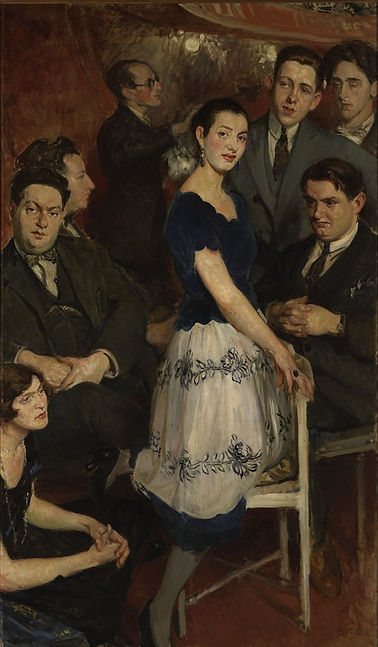
pictured: "Les Six" : Georges Auric, Arthur Honegger, Francis Poulenc, Darius Milhaud, Germaine Tailleferre. The final member, Louis Durey , is not pictured.
Sonata for Oboe and Piano
I. Élégie
II. Scherzo
III. Déploration
Francis Poulenc
Francis Poulenc (1899-1963) was born in Paris. His parents forbade him from enrolling in music school, so he was largely self-taught. He was a pianist and composer who developed an aversion for Maurice Ravel after an unhappy encounter with the impressionist composer. This could be a reason as to why he strayed from impressionism and developed his own style borrowing from the lushness of late-romantic German works such as that which opens tonight’s program.
We tend to imagine that people such as Claude Debussy, Erik Satie, Francis Poulenc, Amedeo Modigliani, and Pablo Picasso had separate lives and existed in their own independent artistic spaces. This notion couldn’t be farther from the truth. The aforementioned composers and visual artists were acquainted and in 1917 when concert halls were closed because of world war one, these young artists met at Salle Huyghens which is French for Hall Huyghens. Located in the 14th arrondissement of Paris, this was the studio of painter Émile Lejeune and it served as a place for musicians to perform and collaborate, as well as a space for artists to display their work. These gatherings sparked the idea to establish groups such as Les Six meaning The Six. They defined themselves as composers who were against the musical style of Richard Wagner and the impressionist music of Claude Debussy and Maurice Ravel.
Trio for Oboe, Horn, and Piano
I. Allegretto
II. Presto
III. Andante Con Moto
IV. Allegro
Heinrich von Herzogenberg
Heinrich von Herzogenberg (1843-1900) was an Austrian composer who studied law, philosophy and political science at the university of Vienna before turning his energy toward music. His wife was a student of Brahms and some consider Herzogenberg to be an epigone of Brahms, meaning he is a less distinguished imitator. On the contrary, many consider Herzogenberg’s works to be a showcase of originality. This trio is one of many chamber works he composed.
It is debated which order of movements for this trio is intended. Considering Herzogenberg likely took structural guidelines from classical music because of his admiration of Bach’s work, we could expect the order of movements to go in a fast-slow-fast pattern. The recordings that have the piece programmed as such also tend to omit the fourth movement likely because of difficulty. Because Herzogenberg is recognized as taking artistic liberties, I have programmed this piece how many others do: fast-fast-slow-fast, with the second movement being “in 3” meaning it feels like a dance, and the fourth movement ending the recital.
